This guide is not another list of ideal bedtime habits. Its purpose is to help you determine whether your real-life schedule is plausibly contributing to poor sleep—or whether your symptoms deserve a broader medical review.
One bad night rarely identifies a cause. Stress, illness, travel, caregiving, noise, pain, weather, and unfamiliar surroundings can all disrupt sleep temporarily. Lifestyle becomes a stronger suspect when a symptom repeatedly appears after a particular behavior and improves when that behavior is absent.
The most useful question is not “Do I have perfect sleep habits?” Ask instead: “Does my sleep reliably change when my schedule, caffeine timing, evening activity, alcohol use, naps, or sleep opportunity changes?”
First, separate sleep opportunity from sleep quality
These are related but different problems. Insufficient sleep opportunity means your schedule does not leave enough time to sleep. Poor sleep quality means you allow adequate time but sleep remains fragmented, difficult, or unrefreshing.
Clues that opportunity is too short
- You routinely have fewer than seven hours between bedtime and the alarm.
- You sleep much longer when no alarm is required.
- Streaming, work, gaming, chores, or scrolling regularly delay bedtime.
- Your alertness improves after several nights with more time available for sleep.
Clues that quality may be impaired
- You allow seven to nine hours but still wake exhausted.
- You awaken repeatedly without an obvious environmental cause.
- Someone notices loud snoring, gasping, choking, or breathing pauses.
- Pain, reflux, leg discomfort, unusual movements, or medication effects disturb the night.
Adults are generally advised to obtain about seven to nine hours of sleep, although individual needs vary. Time in bed is not the same as time asleep, so a seven-hour window may provide less than seven hours of actual sleep.
Six patterns that point toward a lifestyle contribution
Your symptoms follow the workweek
Feeling progressively worse from Monday through Friday, followed by substantially longer sleep on days off, can indicate accumulated sleep loss. Weekend recovery does not prove that short sleep is the only problem, but it shows that weekday demands and sleep opportunity deserve attention.
Your bedtime drifts even when you intend to sleep
Sometimes the main issue is not an inability to sleep—it is repeatedly postponing the attempt. Automatic video playback, unfinished work, household tasks, and endless feeds can quietly remove an hour or more from the available sleep window.
Caffeine is solving one problem while extending another
Caffeine can temporarily improve alertness but cannot replace sleep. Its effects may remain noticeable for several hours, and sensitivity differs widely. A cycle can develop in which short sleep leads to later caffeine use, which then makes the next sleep period more difficult.
Your schedule shifts by several hours
Large differences between workdays and free days can place sleep at odds with the body’s sleep-wake timing. A common clue is being unable to fall asleep on Sunday night after sleeping and waking much later over the weekend.
Evening choices predict awakenings
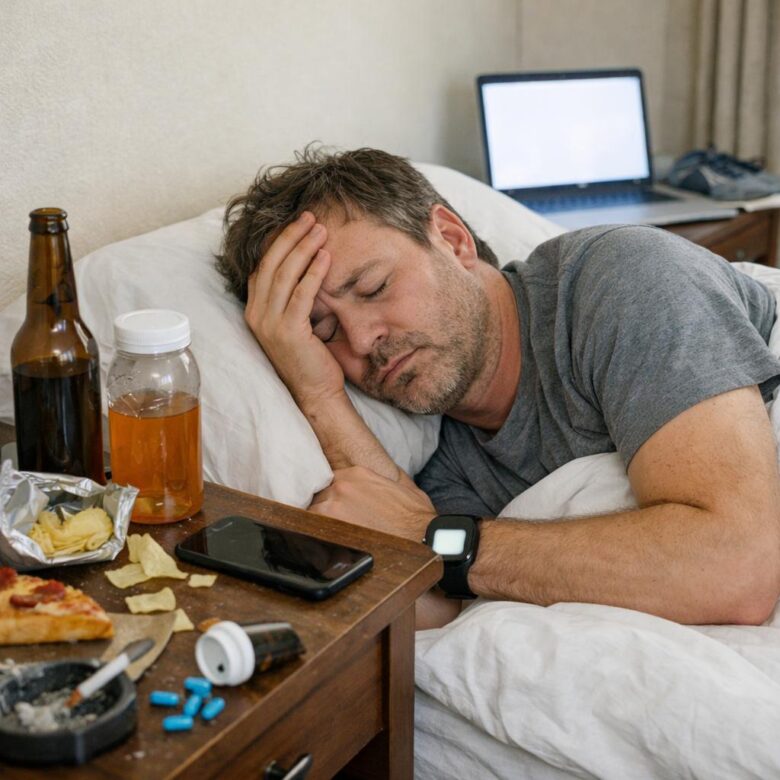
Large late meals may contribute to fullness or reflux, excessive fluids may increase bathroom trips, and alcohol can produce initial drowsiness followed by lighter or more interrupted sleep. Alcohol may also worsen sleep-related breathing problems in some people.
Naps repeatedly interfere with the next night
Naps are not inherently unhealthy and may be useful after an unusually short night or for people with nonstandard schedules. However, a long or late nap can reduce the drive to sleep at the intended bedtime for some people.
What a pattern can—and cannot—tell you
| What you observe | What it may suggest | What it does not prove |
|---|---|---|
| You feel better after several nights with more sleep opportunity. | Insufficient sleep was probably contributing. | That no other sleep or health problem is present. |
| Earlier caffeine timing is followed by easier sleep onset. | Caffeine timing may be relevant. | That caffeine explains awakenings, snoring, pain, or every difficult night. |
| You sleep poorly after drinking alcohol. | Alcohol may be disrupting sleep continuity. | That alcohol is the only cause of fatigue. |
| You remain exhausted despite a stable schedule and adequate time in bed. | Lifestyle may not fully explain the problem. | A particular diagnosis; professional assessment may be needed. |
Run a focused 10-day pattern audit
Change only one major variable at a time. Otherwise, you may not know whether any improvement came from caffeine timing, a longer sleep window, fewer interruptions, or normal night-to-night variation.
Bedtime, estimated sleep onset, awakenings, final wake time, naps, and how rested you felt.
Caffeine, alcohol, evening meals, exercise, late work, screens, pain, stress, and medication timing.
Look for a pattern across several comparable days rather than judging one unusually good or bad night.
A simple decision framework
- Confirm adequate opportunity: Is enough time actually available for sleep?
- Identify the most repeatable trigger: Choose one—not every possible imperfection.
- Make a practical, low-risk adjustment: Examples include protecting the sleep window, moving caffeine earlier, limiting late work, or addressing noise and light.
- Observe several nights: Track both nighttime sleep and daytime function.
- Escalate appropriately: If adequate opportunity and reasonable routine changes do not help, bring the record to a healthcare professional.
Signs that should not be dismissed as “just lifestyle”
Arrange a professional evaluation if you experience:
- Loud, frequent snoring with gasping, choking, or witnessed breathing pauses
- Severe daytime sleepiness or unintended sleep episodes
- Persistent exhaustion despite allowing adequate time to sleep
- An urge to move the legs with uncomfortable sensations that worsen at rest
- Unusual movements, behaviors, falls, or injuries during sleep
- Sleep difficulty that is frequent, prolonged, worsening, or impairing daily life
- A clear sleep change after starting or changing a medicine
Do not drive if you are struggling to keep your eyes open, drifting from your lane, missing exits, or forgetting part of the journey. Pull over safely and arrange another way to continue.
If you take trazodone: drowsiness, dizziness, and impaired thinking or movement can occur. Alcohol may worsen some adverse effects. Do not change your dose, timing, or use of trazodone based on a sleep diary or lifestyle article; discuss persistent morning sedation, dizziness, interactions, or sleep problems with your prescriber or pharmacist.
Frequently asked questions
Does sleeping longer on weekends prove I am sleep-deprived?
Not by itself, but repeatedly needing much more sleep on free days is a useful clue that weekday sleep opportunity may be too short. Illness, irregular schedules, and sleep disorders can also affect weekend sleep.
Can a wearable identify the lifestyle habit causing poor sleep?
A wearable may help show approximate timing trends, but it cannot establish the cause of poor sleep or diagnose sleep apnea, insomnia, or another disorder. Combine device data with symptoms and a simple diary.
How long should I observe a change?
Environmental changes may help immediately, while schedule-related patterns often require several comparable days. Seek medical guidance sooner for dangerous sleepiness, breathing symptoms, medication concerns, or major impairment.
What should I bring to a medical appointment?
Bring one to two weeks of sleep notes, a medication and supplement list, caffeine and alcohol timing, descriptions from a bed partner if relevant, and examples of how sleepiness affects work, concentration, mood, or driving.
Sources & References
- National Heart, Lung, and Blood Institute — How Much Sleep Is Enough?
- National Heart, Lung, and Blood Institute — Insomnia Diagnosis and Sleep Diaries
- National Heart, Lung, and Blood Institute — Sleep Apnea Symptoms
- MedlinePlus — Caffeine
- CDC/NIOSH — Driver Fatigue
- MedlinePlus — Trazodone Drug Information
Learn how this website prepares and updates informational content in our Editorial Policy and Research Methodology.

The Trazodone Insights Editorial Team prepares general educational content about sleep habits, rest, nighttime routines, stress-related sleep topics, and related wellness subjects. The website does not provide individualized medical care.