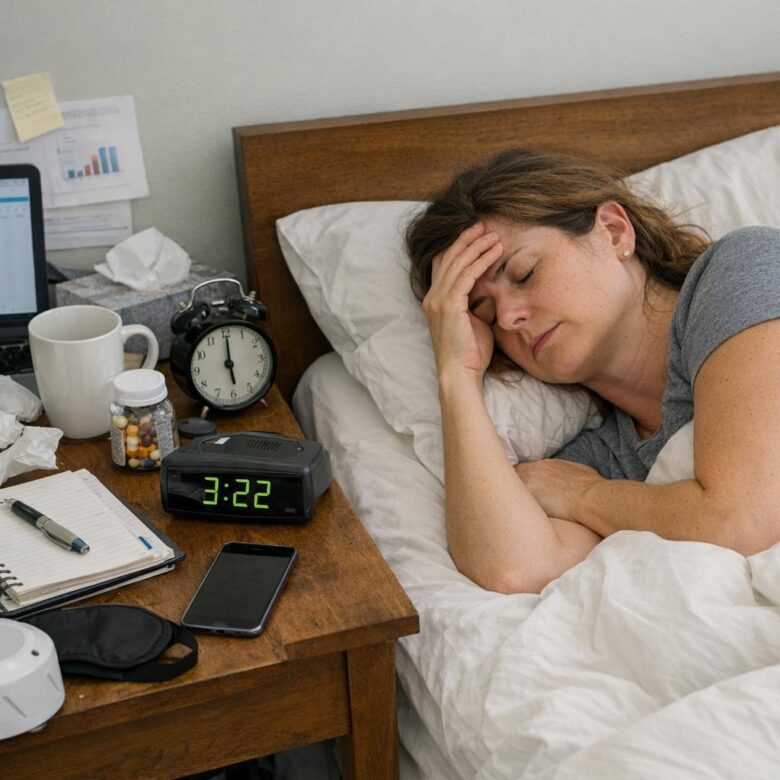
Stress can interfere with sleep in more than one way. It may keep the body alert, fill quiet moments with unresolved concerns, change daytime behavior, or create anxiety about sleep itself. Identifying which part of the cycle is active helps you choose a more useful response.
A difficult deadline, conflict, illness, financial uncertainty, caregiving demand, major life change, or traumatic event can temporarily disrupt sleep. Some people struggle to fall asleep; others wake during the night or earlier than intended. Stress can also produce tension, restlessness, headaches, digestive discomfort, or a noticeably faster heartbeat.
These reactions do not mean that every sleep problem is caused by stress. Pain, breathing disorders, mood conditions, changing schedules, substance use, menopause, medication effects, and other health issues can produce similar symptoms. The useful question is not simply “Am I stressed?” but “What pattern is keeping me awake, and is another explanation possible?”
Important distinction: short-term sleep disruption during a stressful period often improves as the situation settles. Sleep trouble that continues after the original stress has eased may have developed its own maintaining cycle and deserves a closer look.
Why stress can keep sleep out of reach
The brain identifies a demand, uncertainty, conflict, or possible threat that requires attention.
Breathing, heart rate, muscle tension, vigilance, and mental activity may increase.
Clock-checking, problem-solving, and trying to force sleep add another layer of alertness.
Fatigue may lead to extra caffeine, irregular sleep, canceled activities, or more worry about the next night.
The stress response is designed to support action, while sleep depends on a sufficient opportunity to disengage from action. This is why feeling exhausted does not always mean feeling sleepy. A person may have low energy while remaining mentally or physically alert.
Match the response to the pattern
Stress-related sleep difficulty is not one problem with one solution. Use the following patterns as a practical sorting tool rather than as a diagnosis.
| Pattern | What may be happening | A useful first response |
|---|---|---|
| Your mind starts planning as soon as the room becomes quiet. | Unfinished decisions have no scheduled place elsewhere in the day. | Set an earlier review period and record one next action for each concern. |
| You feel tense, restless, or “wired but tired.” | Physical arousal remains high even when active tasks have ended. | Use gentle muscle release, quiet movement, familiar audio, or comfortable unforced breathing. |
| You repeatedly check the time and calculate remaining sleep. | Concern about sleep has become a new stressor. | Turn the clock away and shift the goal from “make sleep happen” to “rest without monitoring.” |
| You spend increasingly long periods awake in bed. | The bed may be becoming associated with wakefulness, frustration, or work. | When safe, move to a quiet place in dim light and return when sleepiness increases. |
| The problem continues even on calmer days. | The original stressor may no longer be the only factor maintaining the sleep problem. | Track the pattern and discuss persistent symptoms with a qualified healthcare professional. |
What to do before, during, and after a difficult night
A 24-hour interruption plan
Contain the stressor
Write down what remains unresolved, the next realistic action, and when you will return to it. Avoid opening new work, financial, or emotionally demanding tasks late in the evening when possible.
Reduce effort
Do not turn relaxation into a test. Stop clock-checking and use a low-stimulation activity. If remaining in bed is creating frustration, consider leaving it briefly when doing so is safe.
Protect the next night
Return to a reasonably consistent schedule rather than spending the entire day in bed. Use caution with driving or hazardous work if you are very sleepy, and notice whether caffeine or alcohol is extending the cycle.
For mental alertness
- Give planning a defined time outside the bedroom.
- Write a short next-action list rather than a detailed journal.
- Silence nonessential work and news alerts.
- Use familiar, low-stakes reading or audio.
For physical tension
- Unclench the jaw and allow the shoulders and hands to soften.
- Try progressive muscle release without straining.
- Choose gentle movement if sitting still increases discomfort.
- Stop any exercise that causes dizziness, panic, pain, or breathing difficulty.
Relaxation methods can help produce a calmer state, but they do not guarantee sleep. Breath-focused, eyes-closed, or meditation exercises can also increase anxiety or intrusive thoughts for some people. An eyes-open grounding exercise, quiet music, gentle movement, or another neutral activity may be more comfortable.
A short log can reveal what memory misses
When sleep is difficult, it is easy to remember the worst nights and overlook patterns. A simple log kept for one or two weeks can help you and a healthcare professional distinguish a temporary stress response from a recurring problem. It does not need to record every minute.
Record these four points each morning
Approximate bedtime, time to fall asleep, awakenings, final wake time, and estimated total sleep.
The main stressor, when it appeared, and whether it involved thoughts, physical tension, or both.
Caffeine timing, alcohol, naps, pain, illness, schedule changes, and prescribed or over-the-counter medicines.
Sleepiness, concentration problems, irritability, unintentional dozing, or difficulty completing ordinary tasks.
Avoid using the log as a nightly scorecard. Its purpose is to identify trends, not to create pressure for perfect sleep.
When the problem may be more than temporary stress
Consider speaking with a qualified healthcare or mental-health professional when sleep difficulty is persistent, worsening, or significantly affecting safety, mood, concentration, work, study, or relationships.
Professional assessment is particularly important when you notice:
- Loud snoring, gasping, choking, or witnessed pauses in breathing
- Severe daytime sleepiness or falling asleep unintentionally
- Persistent panic, dread, low mood, hopelessness, or loss of interest
- Unusually high energy, impulsivity, racing thoughts, or a greatly reduced need for sleep
- Regular use of alcohol, cannabis, or other substances to induce sleep
- Sleep changes that began after a medication or supplement change
- Pain, reflux, hot flashes, breathing symptoms, or frequent nighttime urination
- Sleep difficulty on at least three nights a week that has continued for three months or longer
Cognitive behavioral therapy for insomnia, or CBT-I, is a structured treatment recommended for long-term insomnia. It includes more than general sleep hygiene and may address sleep-related worry, time awake in bed, scheduling, and behaviors that maintain insomnia. Techniques that deliberately restrict time in bed should be individualized rather than improvised from a brief online description.
Questions to prepare for an appointment
- Could pain, breathing, mood, hormones, substances, or another health issue be contributing?
- Could any of my prescriptions, over-the-counter medicines, or supplements affect sleep?
- Would a sleep diary, CBT-I, counseling, or evaluation for another sleep disorder be appropriate?
- What should I do when daytime sleepiness affects driving or work safety?
- Which symptoms should prompt urgent medical attention?
Medication safety: Do not start, stop, increase, reduce, combine, or change the timing of trazodone or another medicine based on this article. Alcohol and other substances or medicines that cause sedation can increase sleepiness or dizziness with trazodone. Discuss interactions and continuing sleep problems with a prescriber or pharmacist.
Frequently asked questions
Can one stressful event cause several nights of poor sleep?
Yes. Short-term insomnia can follow stress, grief, illness, travel, environmental change, or schedule disruption and may last for days or weeks. Seek advice if symptoms are severe, do not improve, or substantially impair daytime functioning.
Why am I exhausted but unable to fall asleep?
Low energy and sleepiness are not identical. Stress can leave you fatigued while attention, muscle tension, or worry remains elevated. Other health and sleep conditions can produce the same experience, so persistent symptoms should not automatically be attributed to stress.
Should I stay in bed until sleep happens?
Spending long, frustrated periods awake in bed may strengthen the association between bed and alertness. When it is safe and physically practical, a quiet activity elsewhere followed by a return to bed when sleepy is one component used in CBT-I.
Is sleep hygiene enough for chronic insomnia?
Healthy routines can support sleep, but current clinical guidance does not treat sleep hygiene alone as a complete intervention for chronic insomnia. CBT-I combines several behavioral and cognitive components in an individualized plan.
When is stress-related distress an emergency?
In the United States, call or text 988 for immediate crisis support if you are thinking about suicide or self-harm. Call 911 for a life-threatening situation, severe breathing difficulty, chest pain, fainting, sudden confusion, a suspected overdose, or an inability to remain safe.
A useful starting point
Begin by identifying the strongest link in your own cycle: unresolved planning, physical tension, clock-checking, long periods awake in bed, or next-day behaviors that make the following night harder. Choose one response that directly addresses that link instead of adding a long list of bedtime rules.
If sleep remains difficult after the immediate stress has passed, or if the pattern includes significant mood, breathing, medication, substance-use, or safety concerns, professional assessment is more useful than simply trying harder to relax.
Sources & References
- National Heart, Lung, and Blood Institute — Insomnia Causes and Risk Factors
- National Heart, Lung, and Blood Institute — Insomnia Treatment and CBT-I
- National Institute of Mental Health — I’m So Stressed Out! Fact Sheet
- National Center for Complementary and Integrative Health — Relaxation Techniques: What You Need to Know
- Department of Veterans Affairs and Department of Defense — 2025 Clinical Practice Guideline for Chronic Insomnia Disorder and Obstructive Sleep Apnea
- U.S. Food and Drug Administration — Trazodone Hydrochloride Prescribing Information and Medication Guide
Learn how this website prepares and updates informational content in our Editorial Policy and Research Methodology.

The Trazodone Insights Editorial Team prepares general educational content about sleep habits, rest, nighttime routines, stress-related sleep topics, and related wellness subjects. The website does not provide individualized medical care.