The most useful evening habit is not necessarily the most popular one. It is the habit that removes the obstacle most likely to be disrupting your sleep.
Long bedtime routines often fail because they ask people to change everything at once. A better approach is to identify what is happening on difficult nights—mental activation, late caffeine, uncomfortable meals, environmental disruption, or too much awake time in bed—and test one targeted change.
Evening habits can make sleep more likely by reducing alerting signals and improving comfort. They cannot guarantee a particular amount of “deep sleep,” and they are not a substitute for evaluating persistent insomnia, sleep apnea, medication effects, or another health problem.
Match the habit to the sleep barrier
| Pattern you notice | Possible evening barrier | First change worth testing |
|---|---|---|
| Your body is tired, but your mind continues planning or replaying the day. | Unfinished tasks and mental activation | Create a written “tomorrow list” before the wind-down period begins. |
| You repeatedly delay bedtime while scrolling, working, gaming, or watching videos. | Stimulating content and a missing stopping cue | Set a content cutoff and prepare a quieter alternative in advance. |
| You fall asleep but wake with reflux, thirst, fullness, or a need to urinate. | Meal, alcohol, or fluid timing | Record evening intake and symptoms rather than banning foods at random. |
| You feel unexpectedly alert at bedtime. | Caffeine, nicotine, bright light, or vigorous late activity | Track timing for several days and move the most likely alerting factor earlier. |
| Noise, light, heat, pets, or notifications wake you. | A repeated environmental disturbance | Correct the largest disturbance first instead of buying multiple sleep products. |
| You become frustrated while lying awake and checking the clock. | Bedtime pressure and prolonged wakefulness in bed | Hide the clock and use a calm, low-light activity rather than trying harder to force sleep. |
Six targeted evening habits
Create a clear end to problem-solving
Work messages, household decisions, studying, and emotionally difficult conversations can keep the brain oriented toward action. Choose a realistic point after which nonurgent problems are recorded rather than solved.
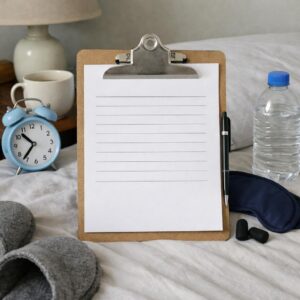
A useful shutdown note includes the unfinished issue, the next physical action, and when you will revisit it. “Email Sam at 9 a.m.” is easier to set aside than the vague instruction “deal with project.”
Reduce the most alerting part of screen use
Light is an important signal for circadian rhythms, but screen use is not only a light issue. Notifications, rapid scrolling, work, upsetting news, and competitive games can also maintain alertness.
Instead of treating every device the same, remove the activity that most often extends your night. Lowering brightness may help with light exposure, but it will not make stressful content relaxing.
Work backward when reviewing caffeine
Caffeine sensitivity varies, and caffeine can come from coffee, tea, cola, energy products, chocolate, supplements, and some medicines. Record the product, amount, and time rather than relying on memory.
If bedtime alertness is a recurring problem, compare nights after earlier and later caffeine use. Avoid changing caffeine, exercise, meal timing, and screen use simultaneously, because you will not know which change mattered.
Separate alcohol-related drowsiness from sleep quality
Alcohol may cause initial sleepiness, but it can contribute to lighter or more interrupted sleep later. It may also aggravate snoring or breathing-related sleep problems in some people.
Alcohol can worsen medication side effects. MedlinePlus advises people taking trazodone to ask their healthcare professional about safe alcohol use because alcohol can intensify trazodone’s effects.
Use symptoms to guide food and fluid timing
A large late meal may contribute to fullness or reflux, while going to bed very hungry can also be uncomfortable. Excess fluid may increase bathroom trips, but inappropriate fluid restriction can create other problems.
Track the symptom that actually occurs—hunger, reflux, thirst, bloating, or urination. People with diabetes, kidney or heart conditions, swallowing problems, or medically directed diets need individualized guidance.
Prepare the bedroom for its biggest repeated disturbance
A sleep-supportive room is generally dark, quiet, comfortable, secure, and not excessively warm. The useful adjustment depends on the problem: window coverings for outdoor light, muted notifications for phone interruptions, or steady background sound for unpredictable noise.
Safety takes priority. Someone at risk of falling may need a clear route and a night-light even if a darker room would otherwise be preferred.
A minimum viable wind-down
On a busy night, use three transitions instead of abandoning the routine completely.
Record tomorrow’s first task and stop nonurgent work.
Lower unnecessary light and silence alerts that can wait.
Repeat one quiet activity, such as washing up, reading, or calm audio.
Run a seven-night habit experiment
A short record is more informative than judging a habit after one unusually good or bad night. The NHLBI sleep diary tracks sleep timing, daytime sleepiness, caffeine, alcohol, medicines, and exercise.
- Choose one problem: for example, late alertness or repeated noise.
- Select one change: such as moving caffeine earlier or muting notifications.
- Keep other routines reasonably stable: avoid testing five changes together.
- Record outcomes: approximate bedtime, awakenings, wake time, and next-day sleepiness.
- Review the pattern: keep the change if it is practical and appears helpful; otherwise test a different barrier.
Do not use a diary to grade yourself or calculate sleep obsessively. Its purpose is to identify patterns and provide useful information if you seek professional care.
If your “evening” happens in the morning
For night and rotating-shift workers, the relevant period is the hour before the main sleep episode, not the conventional evening. Daylight, commuting, household noise, caffeine timing, and frequent schedule changes may be more important than sunset-based advice.
Fatigue that affects driving, machinery use, clinical work, or other safety-sensitive tasks requires prompt attention. A bedtime routine cannot compensate for insufficient sleep opportunity or an unsafe work schedule.
When habits are not enough
Seek guidance from a qualified healthcare professional if sleep difficulty is persistent, worsening, or substantially affecting concentration, mood, work, driving, or daily activities. Evaluation is particularly important for:
- Loud snoring with gasping, choking, or observed breathing pauses
- Severe daytime sleepiness or unintentional sleep episodes
- Uncomfortable leg sensations that become worse during rest
- Unusual movements, behaviors, or injuries during sleep
- Sleep changes after starting or changing a medicine
- Ongoing insomnia despite adequate time and conditions for sleep
Cognitive behavioral therapy for insomnia, or CBT-I, is a structured treatment recommended for chronic insomnia. It includes more than general sleep-hygiene advice. Components such as sleep restriction should not be improvised from brief online instructions, especially when daytime sleepiness, seizure risk, bipolar disorder, or safety-sensitive work is involved.
Frequently asked questions
How early should I start winding down?
There is no required duration. Start early enough to finish essential tasks without rushing. A repeatable 15-minute transition can be more useful than an elaborate routine you rarely complete.
What if I am not sleepy after completing my routine?
A routine reduces obstacles; it does not switch sleep on. Avoid repeatedly checking the time or treating relaxation as a performance test. If you remain awake and frustrated, a quiet activity in low light may be more helpful than struggling to force sleep.
Do herbal tea, melatonin, or magnesium count as natural habits?
Supplements and herbal products are substances with potential side effects and interactions, not simply habits. Their appropriateness depends on the product, health conditions, medicines, and the reason for the sleep problem. Discuss their use with a qualified healthcare professional or pharmacist.
Can healthy evening habits replace insomnia treatment?
No. They may support sleep and remove avoidable disruption, but sleep hygiene alone is not considered a complete treatment for chronic insomnia. Persistent symptoms deserve assessment and may respond to CBT-I or another condition-specific approach.
A practical starting point tonight
Name the one obstacle that appears most often, choose one small response, and make it easy to repeat. If you cannot identify a pattern, use a brief sleep diary for a week rather than adding more rules.
General education cannot determine the cause of an individual sleep problem. Concerning symptoms, medication questions, and persistent daytime impairment should be discussed with an appropriate healthcare professional.
Sources & References
- National Heart, Lung, and Blood Institute — Insomnia Treatment
- National Heart, Lung, and Blood Institute — Sleep Diary
- Centers for Disease Control and Prevention — About Sleep
- National Institute of General Medical Sciences — Circadian Rhythms
- American Academy of Sleep Medicine — Behavioral and Psychological Treatments for Insomnia
- MedlinePlus — Trazodone Drug Information
Learn how this website prepares and updates informational content in our Editorial Policy and Research Methodology.

The Trazodone Insights Editorial Team prepares general educational content about sleep habits, rest, nighttime routines, stress-related sleep topics, and related wellness subjects. The website does not provide individualized medical care.